
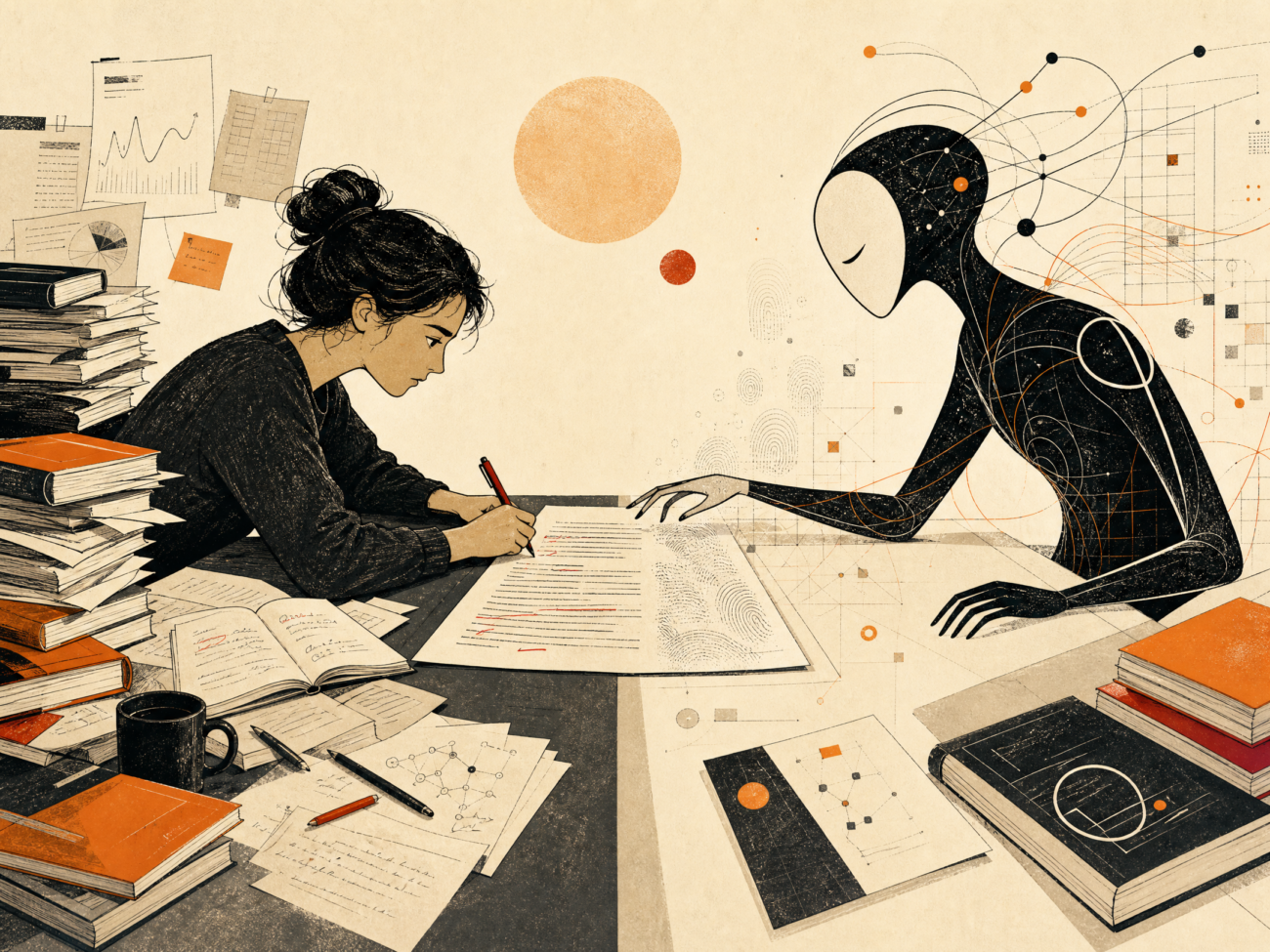
AI tools have become part of everyday academic work. Researchers use Claude and other large language models to improve grammar, restructure paragraphs, summarize literature, refine abstracts, write code, and sometimes help develop entire sections of manuscripts.
Until now, discussions about detecting AI-generated academic writing have largely focused on AI detectors. These tools attempt to determine whether a text was written by artificial intelligence by analyzing linguistic patterns. Their reliability has been widely questioned, particularly when applied to academic writing or text written by non-native English speakers.
Anthropic is now introducing something fundamentally different.
Under its commitments related to the EU AI Act’s transparency requirements, Anthropic has announced that supported Claude models will include machine-readable marks in generated content. For text, this means an invisible watermark embedded directly into Claude’s output. For supported files, Claude will use digitally signed provenance metadata.
For researchers and PhD students, the implications could be significant. A document may potentially carry evidence of Claude processing even when Claude was used only to improve a few sentences.
Here is what researchers need to understand.
1. What Is Claude’s AI Watermark and How Will It Work?
Claude’s new system should not be confused with conventional AI-content detectors.
Traditional AI detectors analyze characteristics of a text and estimate whether it resembles AI-generated writing. They do not normally know whether ChatGPT, Claude, Gemini, or another model actually produced the text.
Claude’s approach introduces a signal during generation itself.
Anthropic describes two main mechanisms.
Invisible watermarks in text
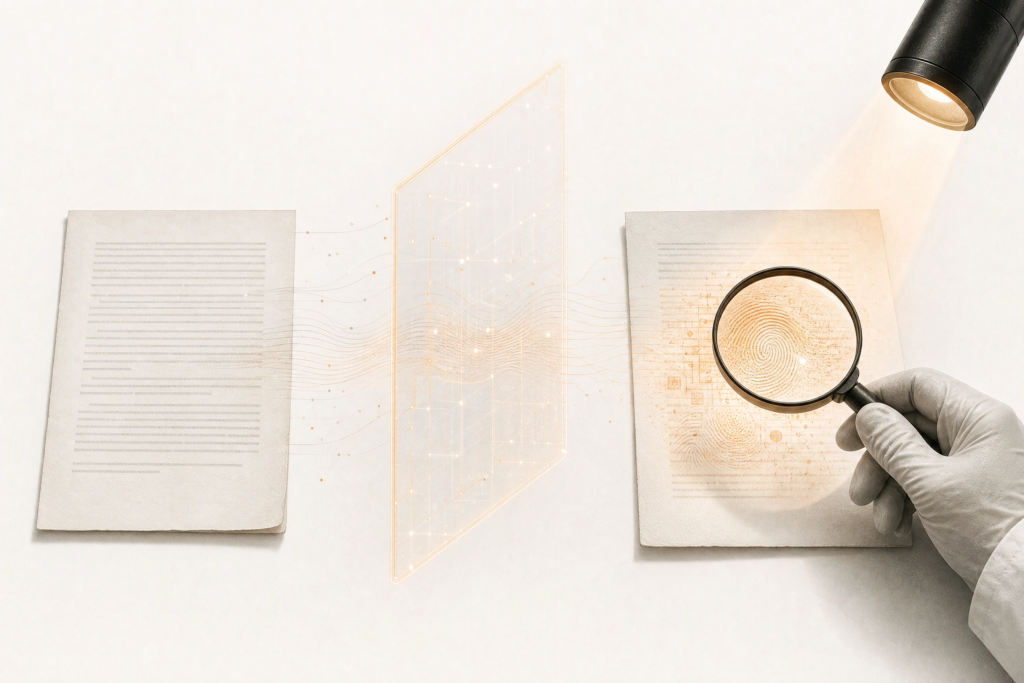
When a supported Claude model generates text, it will embed what Anthropic describes as an imperceptible watermark directly into the output.
Readers will not see a label such as:
“Generated by Claude.”
Instead, the marking will be machine-readable while remaining invisible during normal reading.
Importantly, Anthropic says the watermark is designed to travel with the text when it is copied and pasted. It may also survive some forms of editing.
This means copying a Claude-generated paragraph into Microsoft Word, Google Docs, a thesis, or a manuscript does not necessarily remove the underlying signal.
Anthropic also intends watermarking to operate at the model level. Therefore, it is not limited to people using the Claude website. Supported models accessed through Claude’s API and other supported platforms may also produce marked text.
Provenance metadata for files
The second mechanism applies to supported files.
When Claude generates or processes certain files, including formats such as PNG, JPG, and SVG, Anthropic plans to attach signed provenance metadata using the C2PA standard.
This metadata can provide information indicating that a file was processed by Claude and can help identify subsequent modifications.
There is an important distinction here:
Text watermarking is embedded within generated text, while provenance information is attached to supported files as metadata.
Anthropic also acknowledges that neither mechanism provides perfect proof of AI authorship. A detected mark may indicate that Claude processed the material, but that does not necessarily mean Claude originally created its ideas or content.
This distinction becomes especially important in research.
2. How Could Claude Watermarking Affect Researchers and PhD Students?
The most important implication for academics is surprisingly simple:
Using Claude does not necessarily mean asking Claude to write something from scratch.
Researchers routinely paste their own writing into AI systems and ask:
“Correct the grammar.”
“Make this paragraph clearer.”
“Improve the academic English.”
“Rewrite this sentence professionally.”
“Reduce this abstract to 250 words.”
In these situations, the researcher may have written the original content entirely independently. Claude is functioning primarily as an editing tool.
However, according to Anthropic’s explanation, output processed by a supported Claude model can carry Claude’s machine-readable mark.
That creates an important distinction between AI authorship and AI processing.
Imagine that a PhD student spends several days writing a discussion section. They then paste three paragraphs into Claude and ask it to correct grammar and improve readability.
The scientific reasoning, data interpretation, citations, and original arguments all belong to the researcher.
Nevertheless, the returned text may contain Claude’s watermark.
A future detection system could therefore potentially identify evidence of Claude processing even though Claude did not originate the research.
Anthropic itself explicitly recognizes this limitation. A detected mark does not conclusively establish that Claude authored the underlying material because users may employ Claude for proofreading, translation, summarization, or file conversion.
This matters for academic integrity policies.
Universities and journals will increasingly need to distinguish between several very different activities:
AI-assisted proofreading,
AI-assisted rewriting,
AI-assisted translation,
AI-generated text,
and AI-generated scientific reasoning or analysis.
These are not equivalent uses of artificial intelligence.
For PhD students, the practical lesson is that researchers should no longer assume that minor AI-assisted language editing is necessarily technically indistinguishable from entirely human-edited text.
The safest approach is therefore to understand the AI policies of your university, supervisor, journal, conference, or funding organization before using generative AI on material intended for submission.
3. How Should Researchers Deal With Claude Watermarking?
The goal should not be to defeat or remove AI watermarks. Researchers should instead develop workflows that preserve academic integrity while allowing legitimate uses of AI tools.
Three practices are particularly important.
Disclose AI use when required
The first is transparency.
Many journals, publishers, and universities now have policies governing generative AI. Requirements differ considerably. Some allow AI-assisted language editing without formal disclosure, while others request disclosure of certain uses of generative AI.
Researchers should therefore check the policy of the journal or institution before submission.
When disclosure is required, describe what the tool actually did.
For example, there is a substantial difference between using Claude to improve English grammar and using Claude to generate the interpretation of experimental results.
Accurate disclosure protects researchers far better than trying to predict whether a particular AI detector will recognize their writing.
Use AI suggestions as editing input, not automatic replacement text
The main point here is paraphrasing which can be done either manually or with the help of several other tools, but in both cases the researcher must actively rewrite and refine the text rather than simply accepting an automatic rewrite.
Researchers should treat AI-generated paraphrasing suggestions as input only. The text should be carefully reviewed, adjusted, and rewritten in the researcher’s own academic style. This ensures that the final version still reflects the author’s terminology, reasoning, and voice.
It is important to understand that paraphrasing is a normal academic practice, whether done manually or with tools. However, it should not be used to bypass AI detection systems or to disguise authorship. The focus should remain on improving clarity and expression, not on hiding the use of AI.
Anthropic also notes that heavy paraphrasing, translation, or rewriting can influence whether AI-generated markers remain detectable. This is a technical limitation of watermarking systems, not a method to avoid detection and should not be treated as such.
Pay attention to file metadata
Researchers also need to be aware that AI involvement is not limited to text. Files processed by Claude may include embedded provenance metadata indicating that the tool was used.
This is relevant for a wide range of research outputs, including figures, diagrams, graphical abstracts, presentation slides, and supplementary materials. In many cases, this metadata is not visible when simply opening or viewing the file.
For this reason, researchers should keep clear records of how research files are created, including whether AI tools were used for editing, generating, or modifying visual content. It is also important to check journal or publisher requirements regarding disclosure of AI-assisted figures or materials.
Maintaining original files and documenting the software and tools used in figure creation is now an important part of good research data management practice.
As AI transparency requirements evolve, one principle is likely to become increasingly important in academic publishing:
The question will no longer simply be whether AI touched a document, but what role AI played in producing the research and communicating its findings.
