

Applying for a PhD is an important step in the career of any future researcher. Knowing how to apply for a PhD is not only about securing a place in a doctoral program. The choices you make during the application process can shape your research experience, the skills you develop, the network you build, and ultimately the direction of your future career. Yet the process often begins in a much simpler way: you find a position that looks interesting, read the requirements, compare your CV with the description, and immediately start wondering whether you are good enough. Do you need publications? Is your GPA high enough? Should you contact the professor? Do you need a research proposal? These are reasonable questions, but they can easily shift your attention toward one goal, getting accepted, while overlooking an equally important question: Is this actually the right PhD for you?
A better approach is to treat a PhD application as a matching problem. You have a particular academic background, a set of research skills, questions that interest you, and a direction in which you want to develop. The PhD offers a research problem, supervision, methods, funding, and a research environment. A strong application happens when these two sides genuinely connect. Your first task is therefore not to convince every possible supervisor that you are a good candidate. It is to identify the opportunities where you have a convincing reason to apply and then communicate that reason clearly.
How Do I Find the Right PhD Position?
The easiest way to waste time during a PhD search is to begin with university names. A famous university may offer excellent research opportunities, but its reputation tells you very little about whether a particular project fits your interests. Start instead with the problem you want to investigate. Once that problem is reasonably clear, you can search across disciplines, laboratories, universities, and even different project titles without becoming dependent on a single keyword.
Imagine that your background is in soil science and you want to study greenhouse gas emissions from agriculture. Searching only for “soil science PhD” would miss many relevant opportunities because the same research problem might appear under nitrogen cycling, soil biogeochemistry, sustainable agriculture, climate-smart cropping systems, environmental modelling, or greenhouse gas mitigation. Your search becomes much more effective when you combine the scientific problem with the system and methods that interest you. You might therefore search around nitrogen losses, N₂O emissions, cropping systems, field experiments, modelling, and machine learning rather than around one degree title.
This approach also gives you a simple way to judge whether a position deserves an application. After reading the project description, try to complete the sentence: “This PhD makes sense for me because…” A strong answer will connect your previous experience, the research problem, and what you want to learn next. If your only answer is that the university is prestigious or that you simply want a PhD, you probably have not yet found a strong reason to apply.
How Do I Know if a PhD Is a Good Match for My Profile?
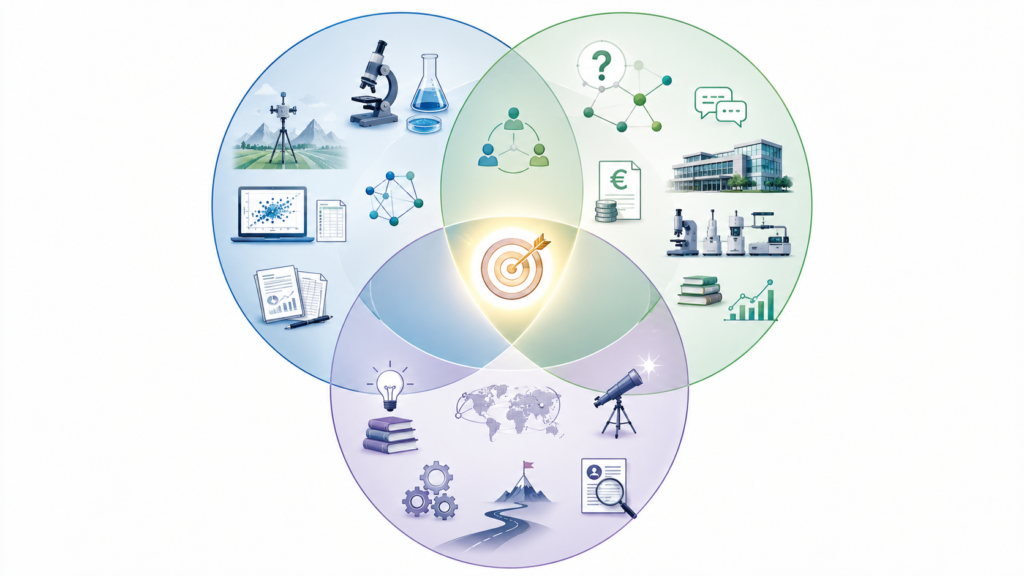
Applicants often interpret “fit” as meaning that they already need every skill mentioned in the advertisement. That is not a useful standard because a PhD is itself a period of research training. A better way to evaluate fit is to look at three dimensions: the research question, your existing foundation, and the direction in which the project would take you.
Suppose you have spent your master’s degree conducting field experiments and analysing environmental data, but you want to become stronger in modelling. A PhD combining field measurements with computational modelling could be an excellent match even if you are not yet an advanced modeller. Your existing experience gives you a credible starting point, while the missing skill gives you a reason to pursue the PhD. By contrast, a project that simply repeats everything you already know may fit your CV perfectly but contribute less to your development.
When evaluating a position, therefore, ask whether you care about the research problem, whether your background gives you enough foundation to begin, and whether the project will teach you something important for your future. The strongest opportunities often sit between complete familiarity and complete unfamiliarity. You should recognize enough of the project to contribute, but there should also be enough that you do not yet know to justify several years of doctoral training.
How Do I Find the Right PhD Supervisor?
Finding a supervisor should involve more than searching for professors who use the same keywords as you. Two researchers can both describe themselves as working on climate change, artificial intelligence, soil science, or cancer biology while investigating completely different questions. What matters is not whether the professor works broadly in your field, but whether their current research direction overlaps with the kind of questions you want to pursue.
Recent publications are particularly useful here. Imagine that you want to study drought effects on soil carbon and you find a professor with an excellent publication record in soil carbon. At first, the match appears obvious. However, after reading their recent work, you discover that the group has moved almost entirely toward continental-scale remote sensing while you want to conduct field experiments on soil processes. Neither research direction is better, but they may lead to very different PhD experiences. Looking at recent projects, publications, collaborators, and current students helps you understand what the group is actually doing now rather than relying on a broad research description written several years ago.
Scientific compatibility is only one part of the decision. A supervisor may be an excellent scientist and still have a supervision style that does not work for you. Once an application becomes serious, try to understand how the group operates. If possible, speak with current students about how often they meet the supervisor, how feedback is provided, how much independence students have, and what happens when a project changes direction. The goal is not to find a supervisor with no weaknesses. It is to determine whether the research and working relationship provide an environment in which you can realistically develop.
Should I Email a Professor Before Applying for a PhD?
Whether you should contact a professor depends on how the particular PhD recruits students, so check the application procedure before doing anything else. If direct contact is appropriate, the most important part of the process happens before you write the email. You need to establish why this particular professor should be interested in speaking with you.
A generic message usually fails to establish that connection. Telling a professor that you are “very interested in their excellent research” may be polite, but it gives them almost nothing to evaluate. Instead, compare your previous work with what their group is currently doing and identify a specific point of overlap. If your master’s research examined fertilizer-driven N₂O emissions and the professor’s group studies nitrogen cycling under water-limited conditions, your connection is not simply that both of you work in soil science. The meaningful connection is that your previous research on fertilizer-related emissions has led you toward questions about how water availability controls nitrogen losses, which is already close to the group’s research direction.
Once you understand that connection, the email becomes much easier to write. Introduce yourself briefly, explain the relevant part of your previous research, describe the question or direction you want to pursue, and show why their group is particularly relevant. You do not need to summarize your entire academic history because your CV can provide that information. The purpose of the email is to make the research connection clear enough that the professor can decide whether a conversation is worth continuing.
A useful final check is to remove the professor’s name and university from the message. If you could send the exact same email to another 20 professors, it is still too generic. A strong first contact should make it obvious why that particular researcher received it.
Do I Need a Research Proposal Before Applying for a PhD?
Not every PhD requires a formal research proposal, particularly when you are applying to an advertised project with predefined objectives. However, even when a proposal is not required, you should be able to explain what kind of research question interests you and why. The purpose is not to design the next four years before you have even met the supervisor. It is to demonstrate that you can move from a broad topic toward a researchable problem.
Consider the difference between saying, “I want to study N₂O emissions because climate change is an important problem,” and explaining that fertilizer increases nitrogen availability but that emission responses under water-limited conditions remain difficult to predict because soil moisture controls several biological processes. The second version immediately creates a research problem. From there, you can ask how soil moisture modifies the relationship between fertilizer application, plant nitrogen uptake, and N₂O losses. Now there is something that can be investigated.
A useful proposal follows this logic throughout: explain what is known, identify what remains unclear, show why that uncertainty matters, formulate the question that follows from it, and explain how you could investigate it. The literature review, objectives, hypotheses, and methods should all serve that same argument. If the reader reaches the third page without understanding what is missing from existing knowledge, adding more background will not improve the proposal. The research gap needs to become clearer.
What Should I Write in a PhD Personal Statement?
The personal statement should not be a written version of your CV. If your CV already says that you completed a master’s degree, worked as a research assistant, attended two conferences, and learned R, repeating those facts in paragraph form adds little value. The statement needs to explain how those experiences changed your research interests and why they lead logically toward the PhD you are applying for.
Imagine that your master’s project involved measuring soil nitrogen under different management practices. During the project, you discovered that environmental variability made the treatment effects difficult to interpret, which pushed you toward statistical modelling. You learned R, started analysing larger datasets, and became interested in combining experiments with predictive approaches. If the PhD you are applying for combines field measurements with modelling, there is now a clear progression from your previous experience to your next research step.
That progression should become the backbone of the statement. Explain where your research experience began, what you learned, what questions emerged, what skills or knowledge you now need, and why this particular PhD provides the appropriate next step. This is much more convincing than repeatedly describing yourself as passionate, motivated, hardworking, or ambitious. Those qualities are difficult to verify when simply stated. A coherent record of choices and experiences allows the reader to infer them.
Do I Need Publications to Get Into a PhD?
Applicants often ask this question as though a publication were a ticket required for admission. A more useful question is what a publication is supposed to demonstrate. Usually, it signals that someone has participated in research, dealt with data or experiments, interpreted results, and communicated scientific work. If you do not have a publication, the task is therefore to show evidence of those abilities through the research experience you do have.
For example, “completed a master’s thesis on drought effects on wheat” tells the reader very little about your research ability. If you explain that you designed an experiment with several water regimes, collected physiological and yield measurements, analysed treatment responses, and identified soil moisture variability as an important limitation, the same experience suddenly becomes informative. It shows that you have dealt with a research question, methods, data, interpretation, and limitations.
The same principle applies to internships, conference presentations, laboratory projects, programming work, field campaigns, and unpublished research. Do not merely name the experience. Explain what you did, what problem you faced, what decisions you made, and what you learned. A publication can strengthen an application, but the broader objective is to demonstrate that you understand what doing research actually involves.
Can I Get Into a PhD With a Low GPA?
When applicants worry about GPA, they often combine two different questions: whether they are eligible to apply and whether they are competitive enough to receive an offer. Separate them. Eligibility can usually be checked against the formal requirements of the program. If you do not meet those requirements, investigate whether alternative qualifications or exceptions exist. If you do meet them, then your GPA becomes one part of a much larger application.
This distinction matters because applicants can spend enormous amounts of time worrying about grades they can no longer change. Suppose your GPA is weaker than you would like, but since graduating you have completed a substantial research project, developed strong quantitative skills, presented your work, and gained experience directly relevant to the proposed PhD. Those developments do not erase the GPA, but they provide more recent information about your ability to conduct research.
Your energy is therefore better spent strengthening the parts of the application that remain under your control. Choose positions where your experience is genuinely relevant, develop a clearer proposal, obtain references from people who know your research ability, and prepare thoroughly for the interview. Instead of repeatedly asking whether a particular GPA is “good enough,” determine whether you meet the requirement and then ask what evidence you can provide today that you are ready for doctoral research.
How Should I Prepare for a PhD Interview?
The most effective place to begin interview preparation is not a list of 50 common questions. It is the application you already submitted. Every important claim in your CV, statement, or proposal can become a question, and you should be able to explain it without relying on memorized language.
If your CV says that you used machine learning, for example, be prepared to explain what you were predicting, why you chose the model, how you evaluated it, and what limitations you encountered. If your proposal claims that soil moisture controls N₂O emissions, be prepared to explain the mechanism rather than simply repeating the statement. If you describe one of your master’s results as important, expect someone to ask why it matters and whether there are alternative interpretations.
Once you can discuss your previous work comfortably, connect it to the proposed PhD. The interview should reveal a logical progression: this is what I have worked on, this is what I learned from it, these are the questions it left me with, and this is why I want to investigate them here. That preparation is much more useful than memorizing polished answers because it also prepares you for questions you did not anticipate. A PhD interview is partly about what you know, but it is also about whether you can think clearly when discussing research.
What Does a Fully Funded PhD Actually Mean?
“Fully funded” sounds like a complete answer, but it should be treated as the beginning of a financial evaluation. What matters is not only the annual stipend written in the offer but what that amount means after tuition, fees, taxes, insurance, housing, and basic living costs are considered.
Imagine two offers. The first provides €24,000 per year and the second €20,000. Looking only at the stipend, the first appears clearly better. But if housing and essential living costs near the first university consume €1,700 per month while the equivalent costs near the second are closer to €1,000, the financial comparison changes significantly. The useful number is therefore not simply the stipend. It is the amount you are likely to have after unavoidable expenses.
The same attention should be given to the research itself. Find out whether conference travel is supported, whether there is a budget for fieldwork or laboratory analysis, whether training costs are covered, and how long the funding is guaranteed. A four-year PhD with only three years of guaranteed funding creates a very different situation from four years of guaranteed support. Before accepting, you should be able to explain exactly how you will be funded and what important costs remain your responsibility.
How Do I Choose Between Two PhD Offers?
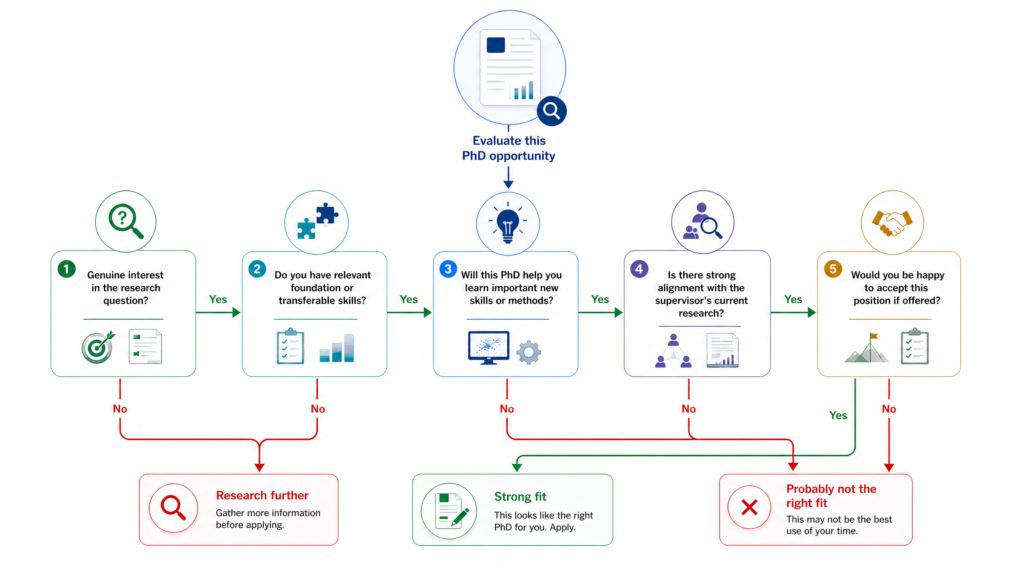
When applicants receive multiple offers, university reputation can easily dominate the decision because it provides a simple comparison. The problem is that rankings do not tell you what your daily research experience will look like. A more useful comparison begins by temporarily removing the university names and evaluating the actual opportunities.
Imagine that one offer comes from a highly prestigious institution but the project only partly interests you, the supervisor manages a very large group, and the PhD would mostly use methods you already know. Another comes from a less famous institution, but the research question strongly interests you, the supervisor works closely with a small team, and the project would give you expertise you specifically want for your future career. The first university may still be the better choice, but its reputation should not make that decision automatically.
Compare the offers according to the things that will shape the next several years: the research question, supervision, skills you will develop, funding security, facilities, collaborators, publication opportunities, professional network, location, and career direction. Then put the university names back into the comparison. Reputation can remain a factor, but now it is competing with information that is much more directly connected to your PhD experience.
A useful final question is: if both universities had exactly the same reputation, which PhD would I choose? The answer often reveals what you actually value.
What Are the Red Flags When Choosing a PhD?
Looking for red flags does not mean trying to find a perfect supervisor or laboratory. Every research group has problems, and one negative comment from one student does not necessarily tell you much. What matters is whether you can identify repeated patterns that could affect your ability to complete the PhD successfully.
Suppose one student tells you that their supervisor once took several weeks to provide feedback. That may simply reflect a busy period. If several students independently tell you that meetings are regularly cancelled and thesis chapters remain unread for months, the information becomes more significant. The same reasoning applies to funding, authorship, workload, student turnover, and project expectations. One isolated problem deserves context. A repeated pattern deserves a direct question.
The application and interview process can also provide useful information. If you ask how funding works and nobody can give you a clear answer, clarify it before accepting. If the project changes dramatically every time you discuss it, find out why. If you are pressured to make a decision before you have received important information, do not allow the excitement of receiving an offer to replace careful evaluation. The purpose is not to search for reasons to reject the PhD. It is to understand the conditions you are agreeing to before making a multi-year commitment.
How Many PhD Programs Should I Apply To?
There is no useful universal number because ten poorly matched applications and ten carefully targeted applications are not equivalent. Instead of deciding that you must apply to five, ten, or twenty programs, build a shortlist based on how seriously you would consider each opportunity if you received an offer.
Suppose you identify twelve positions. Four strongly match your research interests and experience, five are possible matches with some uncertainties, and three interest you mainly because they are available. That information already tells you where your time should go. The four strong matches deserve careful investigation, tailored statements, and serious preparation. The possible matches require more research before you decide. The final three may not deserve an application at all.
This approach also improves application quality because every application has a cost in time and attention. A carefully targeted application requires you to understand the project, investigate the supervisor, adapt your statement, organize references, and sometimes develop a proposal. Before doing all of that, ask yourself a simple question: if this program offered me the PhD tomorrow, would I seriously consider accepting it? If the answer is clearly no, submitting an application simply to increase your numbers achieves very little.
What Should I Check Before Submitting My PhD Application?
Before pressing submit, read the application once from the perspective of someone who knows nothing about you. The selection committee should not have to assemble your story from disconnected pieces of information. They should be able to understand why your previous experience leads naturally toward this particular research opportunity.
A strong application usually contains a visible chain of reasoning. You worked on a particular problem, that experience gave you certain skills and exposed you to unanswered questions, those questions pushed your interests in a particular direction, and the proposed PhD offers the expertise, methods, or environment required for the next step. Your CV provides evidence of the experience, your statement explains the progression, your proposal demonstrates how you think about the research problem, and your references support the abilities you claim to have.
If that connection is difficult to see, adding more achievements or more adjectives will probably not solve the problem. Make the relationship between your past experience and the proposed PhD clearer. The reader should finish your application understanding not only that you want to do doctoral research, but why this particular PhD makes sense as your next step.
That is ultimately the principle that connects the entire application process. Finding a PhD, choosing a supervisor, writing the first email, developing a proposal, preparing for an interview, and evaluating an offer are not separate tasks. They are different stages of the same decision: finding a strong match between your experience, the research question, the supervisor, and the environment in which you want to develop.
The objective is therefore not to apply everywhere and hope that someone chooses you. It is to identify where you genuinely fit, understand why you fit, and communicate that connection clearly. When you approach PhD applications this way, you are not simply improving your chances of receiving an offer. You are also improving your chances of accepting an offer that is actually worth the next several years of your life.
More information on how to write a proposal: https://www.researchrabbit.ai/articles/write-a-research-proposal
