
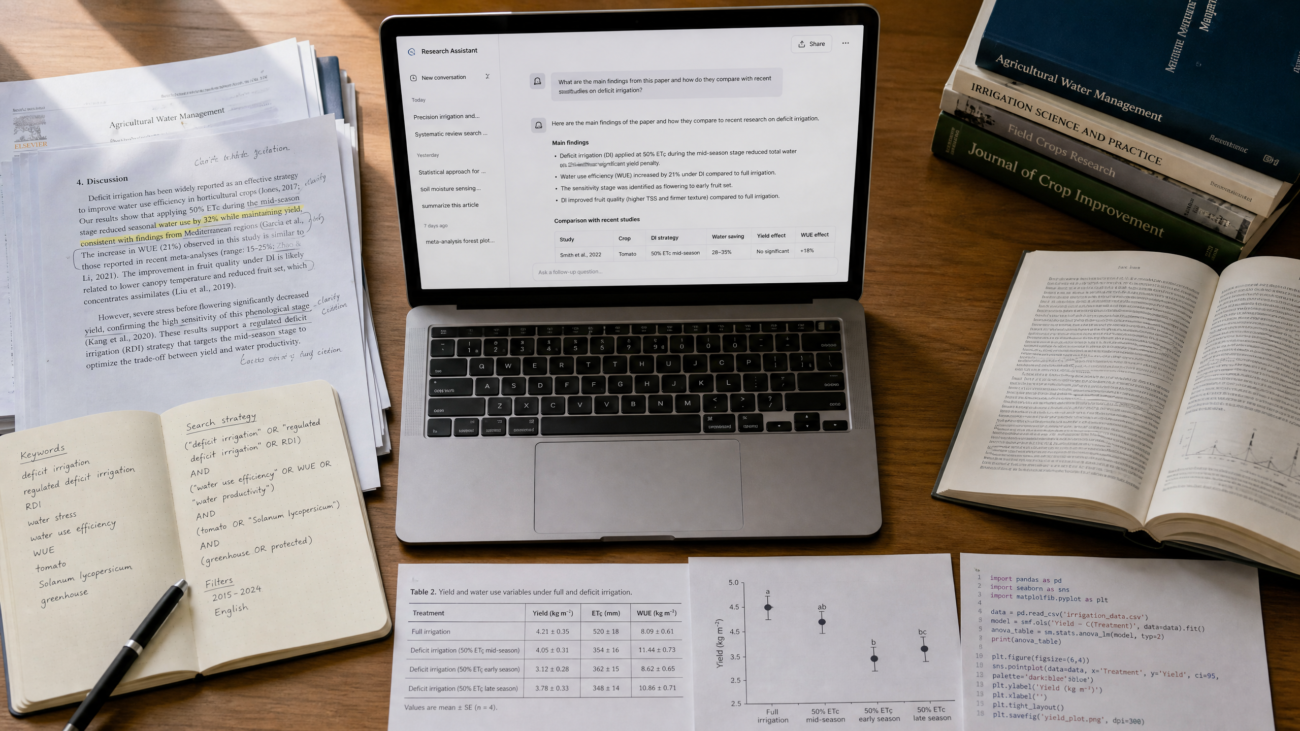
Using ChatGPT for research to complete a thesis or dissertation is the dream of many researchers. Moreover, it helps preserve writing quality and scientific rigor.
How can I use ChatGPT for research correctly in my thesis?
The question is understandable. ChatGPT for research can help, but a thesis can take years to complete. A surprising amount of that time is not spent making scientific discoveries. It is spent writing and rewriting paragraphs. It is spent analyzing data, fixing code, and improving figures. It includes searching for the right papers and managing hundreds of references.
ChatGPT can help with many of these tasks.
However, there is an important difference.
Between using ChatGPT to support your research and asking it to produce the research for you.
I would divide its most useful applications during a thesis into three areas: writing, data analysis, and citations and references.
And in each case, the way you use ChatGPT matters as much as the tool itself.
1. From a Rough Draft to Scientific Writing: Let ChatGPT Improve What You Already Know
Writing is probably the first reason many researchers start using ChatGPT.
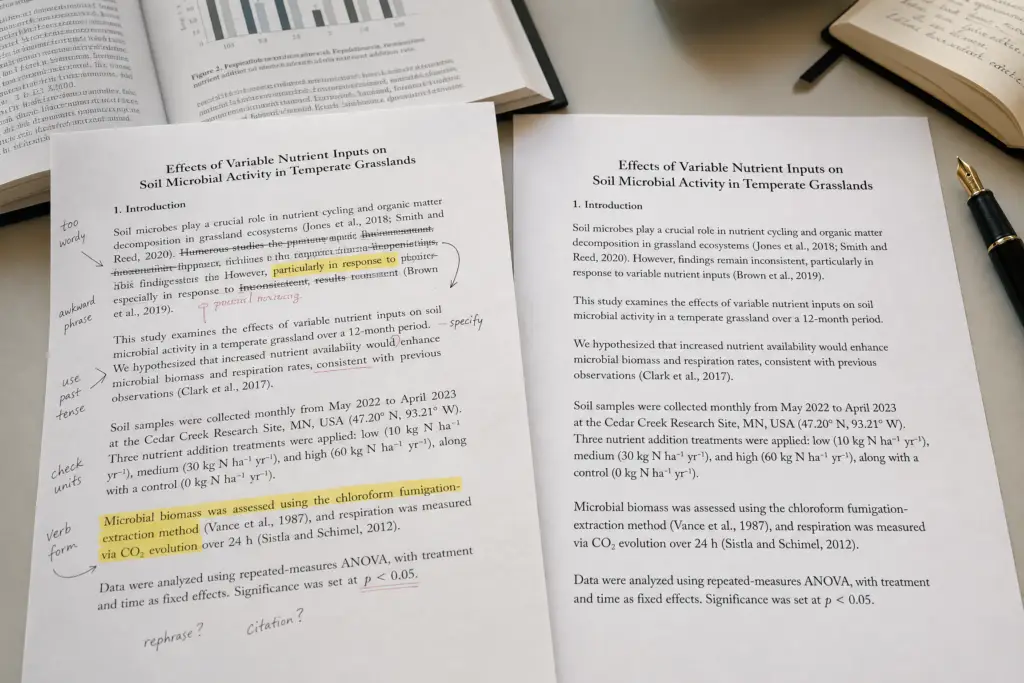
You may have spent several days reading papers for one section of your thesis. You understand the subject, you have collected the relevant information and you know which references support your argument. But when you finally start writing, the result does not sound the way you expected.
The information is correct, but the paragraph is repetitive. The transitions are weak. Some sentences are unnecessarily long. The scientific idea that seemed perfectly clear in your head suddenly becomes difficult to explain on the page.
This is exactly where I think ChatGPT can be valuable.
I would not advise starting with an empty document and asking ChatGPT to generate ready-to-use scientific text and information. Instead, the researcher should first build the scientific foundation of the section.
Read the papers. Extract the information you need. Keep the citations connected to the original information. Then prepare your first draft yourself.
The first draft does not need to sound like a Nature paper. It simply needs to contain the correct scientific information, argument and structure.
Additionally, once that foundation exists, ChatGPT for research can help transform a normal draft. It can improve sentence structure, remove unnecessary repetition, and strengthen the connection between ideas. Moreover, it corrects language problems while preserving your scientific message.
This also changes how you should prompt ChatGPT.
Instead of saying:
“Write a literature review about nitrogen fertilizer and N₂O emissions.”
you could provide your own text and say:
“Improve the academic and scientific writing of this section. Preserve the scientific meaning, numerical values and citations. Improve clarity, coherence and transitions between ideas. Do not introduce new scientific information or references.”
Now ChatGPT has a much clearer job. You provide the science and the evidence; it helps you communicate them more effectively.
Another practice I strongly recommend is working section by section instead of submitting the entire thesis at once.
Take part of your introduction, improve it and read the result carefully. If something does not sound right, ask for another version or explain exactly what needs to change. Once you are satisfied, move to the next section.
This makes it easier to catch errors, control changes in scientific meaning and progressively improve the writing. It can also make your interactions with the tool more efficient because you are working only on the text that actually needs attention.
The prompt is therefore important. ChatGPT should know whether you are improving an Introduction, Materials and Methods, Results or Discussion section because each has a different purpose and style.
A simple workflow works surprisingly well:
Build your scientific information → Write your draft → Give clear instructions to ChatGPT → Improve section by section → Verify the final scientific meaning.
In this workflow, ChatGPT is not replacing your writing. It is helping you turn your scientific knowledge into better scientific communication.
2. From Raw Data to Publication-Ready Figures: Use ChatGPT as a Data Analysis Assistant
Then comes the part of the thesis that can be intimidating even for experienced researchers: data analysis.
You have finished the experiment and finally have the dataset on your laptop. Perhaps you have several treatments, multiple replicates, measurements collected at different times and dozens of variables.
You know the research question you want to answer, but you are not completely sure how to move from that dataset to the appropriate statistical analysis.
This is where ChatGPT can become an amazing assistant, whether you are a beginner or already comfortable with statistics.
The best place to start is not necessarily with the dataset itself. Start by explaining your research.
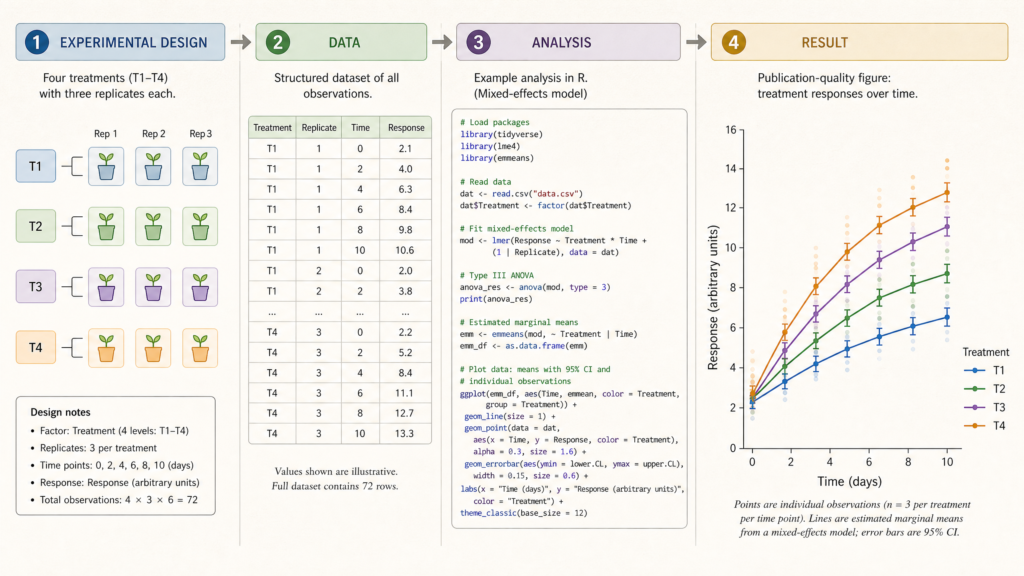
Describe your experimental design, variables, treatments, replicates, sampling strategy and research objectives. Then ask ChatGPT to propose a clear statistical workflow and explain why each step is necessary.
For example, you can describe an experiment and ask:
“Based on this experimental design and research objective, provide a step-by-step statistical analysis plan. Explain which tests or models are appropriate, their assumptions, how I should check those assumptions and how the results should be interpreted.”
This is much more useful than simply asking ChatGPT to “analyze my data.”
It allows you to understand the statistical logic before moving to the code.
Once the analysis plan is clear, you can go further. If you work with R or Python, ChatGPT can help generate the code needed to perform the analysis. It can also help explain the code, identify errors and modify the workflow when something does not work as expected.
ChatGPT’s current data-analysis capabilities can work with uploaded structured data, create tables and charts, perform calculations and statistical analyses, and allow users to review the underlying code and assumptions.
The same approach becomes particularly useful when creating figures.
Suppose your analysis is complete, but the default plot produced by R is far from what you want in your thesis. You can continue working with ChatGPT to improve it. Ask it to modify the labels, legend, fonts, statistical annotations, dimensions or export quality.
You can even provide an image of a scientific figure whose general design you like and ask for help developing R or Python code to create a similar type of visualization using your own data.
The first plot may not be perfect. That is fine. Improve it, show what needs to change and continue until the result matches what you need.
This is where ChatGPT can save considerable time.
But there is one condition: you should understand the analysis you are using.
A code can run perfectly and still implement the wrong statistical approach. ChatGPT can assist with the analysis, but the researcher remains responsible for understanding the experimental design, checking assumptions, validating the results and deciding whether the statistical approach actually answers the research question.
3. From Thousands of Papers to the References You Actually Need
Reference management is one of the most critical and time-consuming parts of a thesis.
The challenge often begins before you have even found the papers.
Imagine that you are preparing your literature review and search Web of Science for your topic. The first query returns 12,000 publications. You add several terms and suddenly get 25.
Neither result is particularly useful.
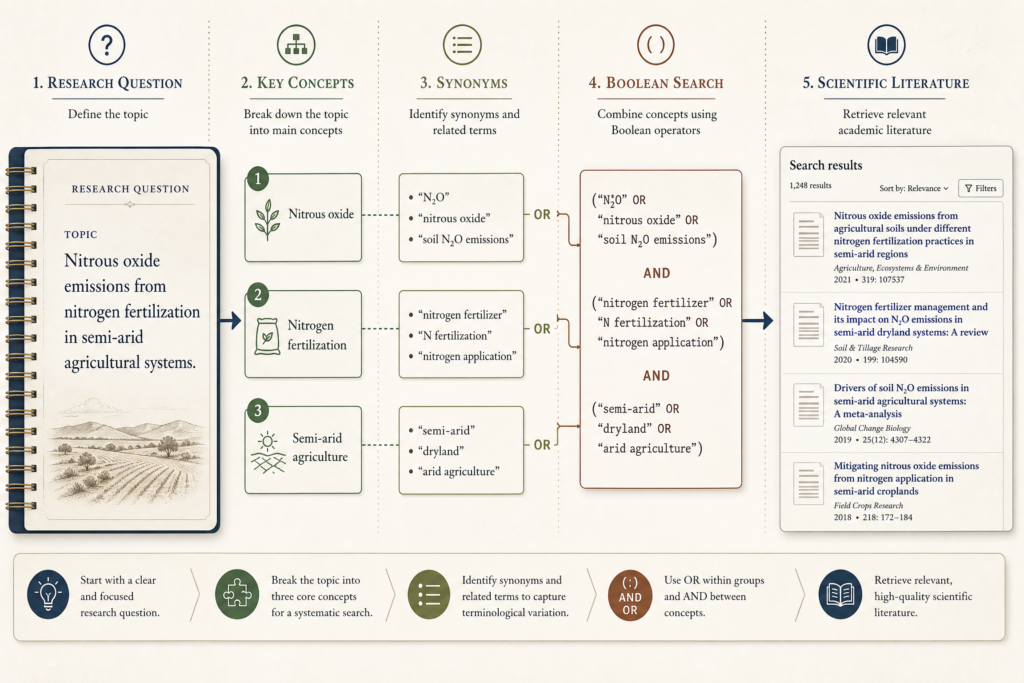
Finding the right literature requires finding the right language to search for that literature, and this is an area where ChatGPT can be very helpful.
You can explain your research question and ask ChatGPT to identify the main concepts, alternative keywords and scientific synonyms. You can then ask it to combine those terms into a Boolean search query specifically formatted for Web of Science or Scopus.
Instead of spending a long time trying different combinations manually, you start with a structured search strategy and improve it based on the results you retrieve.
This is a much better use of ChatGPT than simply asking it to generate a list of references.
There is a scientific reason to make that distinction. Published research has demonstrated that generative AI can produce references that appear convincing but are inaccurate or nonexistent.
The safest approach is therefore simple: use ChatGPT to help you find references, but verify the references through reliable scientific sources before using them in your thesis.
ChatGPT can also become useful again once you already have your bibliography.
After months or years of writing, you may have hundreds of references. Some may be duplicated, some may be formatted differently, and some citations in the manuscript may be missing from the final reference list.
ChatGPT can help inspect the bibliography for duplication, missing references and inconsistencies in citation style. The final verification, however, should always remain with the researcher and the original bibliographic sources.
The Best Use of ChatGPT Is Not Writing Your Thesis for You
When these three applications are considered together, the idea is actually very simple.
Use ChatGPT to improve writing that is built on information you have already verified.
Use ChatGPT to guide and accelerate data analysis while you remain responsible for the statistical decisions.
Use ChatGPT to build better literature searches rather than blindly trusting generated citations.
That is a much more powerful way to use AI in research than asking it to generate a thesis from scratch.
A researcher still needs to understand the literature, experimental design, statistics, results and scientific interpretation. ChatGPT does not remove that responsibility.
What it can remove is some of the unnecessary friction around those tasks.
And over the course of a Master’s thesis or PhD, saving time on writing, coding, figures and reference management can make a significant difference.
The goal is not to let ChatGPT do your research.
The goal is to use ChatGPT so that you can do your research better.
