
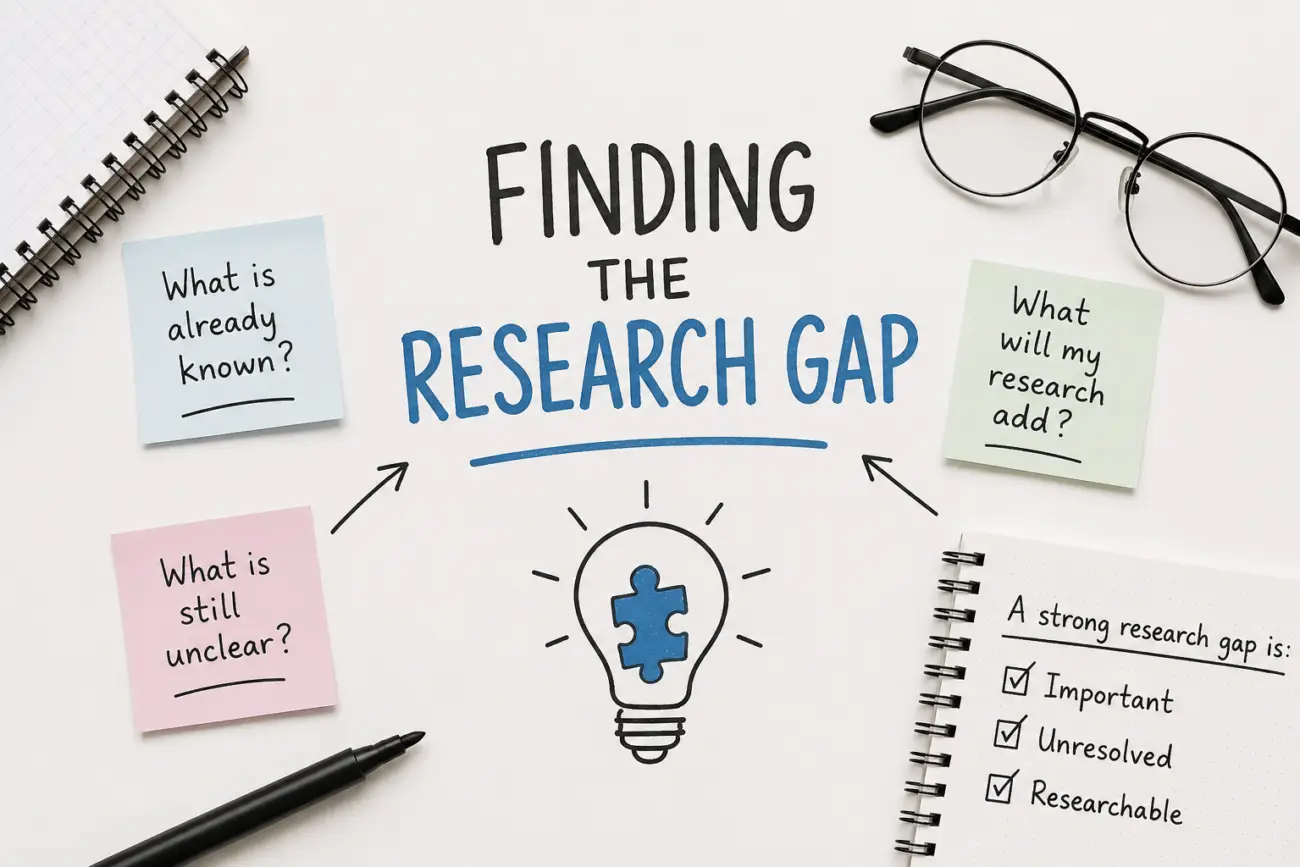
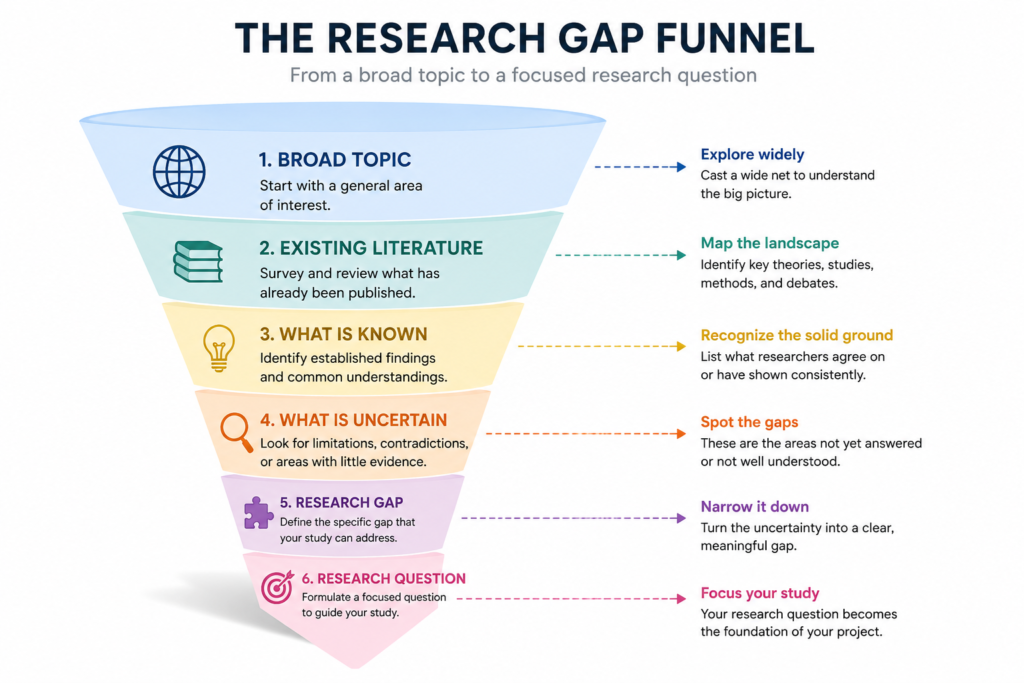
A research gap is one of the foundations of a strong PhD project. Yet it is also one of the concepts that students most often struggle to define.
You may read dozens of papers.
You repeatedly encounter phrases such as ‘further research is needed’.
But which of these actually represents a research gap?
How do you move from reading the literature to identifying a gap that justifies your research?
This process also clarifies how to find a research gap.
The first thing to understand is simple:
A research gap is not merely something that has never been studied. It is something important that the existing research does not yet adequately explain, test, or resolve.
How to find a research gap requires more than searching for an untouched topic.
You must understand what is known, identify where uncertainty remains, and judge whether solving it adds value.
This guide focuses on four questions:
- What exactly is a research gap?
- What types of research gaps can you find?
- How do you identify a research gap in the literature?
- What mistakes should you avoid?
What Is a Research Gap?
A research gap is an important unanswered question, unresolved uncertainty, inconsistency, or limitation in the existing body of knowledge that creates a justified need for further research.
Three elements matter here:
Something is known.
Something important remains uncertain.
Further research could reduce that uncertainty.
Consider this statement:
Few studies have examined soil carbon in Region X.
This identifies limited research activity, but it does not yet establish a meaningful research gap.
Now consider:
Current estimates of soil carbon change are derived mainly from temperate agricultural systems. Their applicability to semiarid environments remains uncertain because differences in soil moisture, vegetation, and decomposition processes may alter carbon dynamics.
This is much closer to a genuine research gap.
Why?
Because it establishes what we know, identifies what we cannot confidently conclude, and explains why the uncertainty matters.
A useful way to think about a research gap is:
What we know → What we do not know → Why we need to know it
That is the core logic behind a strong research gap.
What Is Not a Research Gap?
Before looking at the different types of gaps, it helps to remove some common misconceptions.
“Nobody has studied this exact topic”
Not necessarily a research gap.
There are countless questions that nobody has studied because they are unimportant, impractical, or scientifically unnecessary.
Novelty and significance are not the same thing.
“There are only a few papers”
Also not necessarily a research gap.
Three rigorous studies may provide stronger evidence than thirty weak ones.
The relevant question is not simply how many studies exist, but whether the available evidence is sufficient to answer the question.
“This has never been studied in my country”
Again, not automatically a gap.
A new geographical setting becomes scientifically relevant when there is a reason to expect that context could influence the phenomenon or when locally specific evidence is necessary for an important decision.
“The authors said more research is needed”
This is a useful clue, not proof.
Authors routinely recommend future research. You still need to check whether the question remains unresolved and whether addressing it would meaningfully advance knowledge.
A genuine research gap must therefore be established from the body of evidence, not simply extracted from one sentence in one paper.
The Main Types of Research Gaps
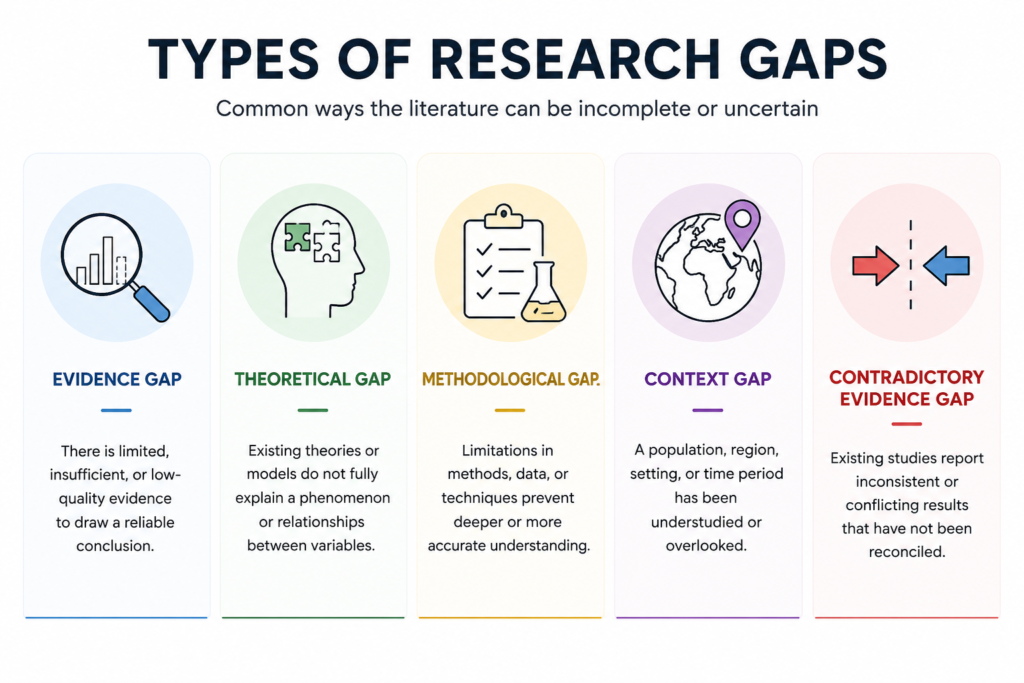
There is no single classification of research gaps that applies perfectly across all disciplines. However, most gaps encountered in PhD research fall into a few recognizable forms.
Understanding these forms makes them much easier to identify.
1. Evidence Gap
An evidence gap occurs when there is not enough reliable evidence to answer an important question confidently.
Research may exist, but it may be too limited, inconsistent, short-term, poorly replicated, or methodologically weak to support a firm conclusion.
For example:
Several short-term studies suggest that management practice X increases soil carbon, but evidence from long-term field experiments remains limited.
The gap is not:
Nobody has studied management practice X.
The gap is:
We still lack sufficient evidence to determine whether the observed effect persists over the long term.
That distinction matters.
An evidence gap concerns the strength, coverage, or adequacy of existing evidence.
2. Theoretical or Explanatory Gap
Sometimes research shows that something happens without adequately explaining why.
Imagine that several studies consistently find that X influences Y.
The relationship appears real, but the mechanism remains unclear.
That creates an explanatory gap.
For example:
Studies consistently report lower emissions under management practice X, but the biological processes responsible for this reduction remain poorly understood.
The next useful study may therefore not be another experiment asking whether X reduces emissions.
It may need to ask:
Why does X reduce emissions?
Theoretical gaps can also arise when competing theories predict different outcomes and existing evidence cannot distinguish between them.
3. Methodological Gap
A methodological gap exists when limitations in existing methods prevent researchers from answering an important question adequately.
For example, previous studies may rely on:
- small samples;
- indirect measurements;
- low temporal resolution;
- limited spatial coverage;
- weak validation;
- short experimental periods; or
- analytical methods unable to capture important relationships.
Suppose previous studies estimated biomass using field measurements from a limited number of plots.
New remote-sensing technology may make it possible to assess biomass across much larger areas.
But there is an important rule:
A new method is not automatically a research gap.
Saying:
“Previous studies used traditional statistics, so I will use machine learning”
does not establish a meaningful gap.
You need to explain what important uncertainty the improved method allows you to address.
4. Context or Population Gap
A context gap occurs when evidence is concentrated in particular populations, environments, countries, sectors, or experimental conditions, leaving uncertainty about whether the findings apply elsewhere.
For example:
Most evidence on the effectiveness of practice X comes from temperate agricultural systems, while its performance under semiarid conditions remains uncertain.
This becomes a meaningful gap if environmental differences are expected to influence the outcome.
The argument should therefore not stop at:
“Few studies have been conducted in semiarid regions.”
It should explain:
Why might semiarid conditions produce a different result?
Without that justification, changing location is simply replication in another setting.
5. Contradictory Evidence Gap
Sometimes there is plenty of research, but the studies do not agree.
This can be one of the strongest forms of research gap.
Imagine that you find:
Study A: X increases Y
Study B: X has no effect on Y
Study C: X decreases Y
The research gap is not the absence of evidence.
It is the lack of a clear explanation for the inconsistency.
The next question becomes:
What explains the differences among these results?
Perhaps the effect depends on:
- climate;
- population characteristics;
- experimental duration;
- measurement technique;
- management conditions;
- sample size;
- environmental conditions; or
- analytical approach.
A PhD study that explains why previous studies disagree can make a substantial contribution.
How to Find a Research Gap
Now comes the practical question.
How do you actually find one?
The most reliable approach is not to search Google Scholar for the phrase “research gap.”
You find gaps by comparing evidence.
Step 1: Understand What Is Already Known
You cannot identify what is missing until you understand what already exists.
Begin with recent review papers in your research area, particularly:
- systematic reviews;
- meta-analyses;
- scoping reviews; and
- high-quality critical reviews.
These papers can quickly show you how the field is structured.
While reading, ask:
What conclusions appear well established?
Where is the evidence weak?
Where do authors disagree?
Which questions keep appearing?
Which populations or conditions dominate the evidence?
What limitations occur repeatedly?
Your goal is to establish the current state of knowledge before looking for what is missing.
Step 2: Read Recent Primary Studies
Review papers give you the big picture, but they may not capture the newest developments.
Next, examine recent primary studies closely related to your topic.
For each paper, record:
| Question | What to extract |
|---|---|
| What was studied? | Research objective |
| Where or in whom? | Context/population |
| How? | Method |
| What happened? | Main result |
| How strong is the evidence? | Uncertainty/validation |
| What could not be answered? | Limitation |
| What remains unresolved? | Potential gap |
Do this across several studies.
You will gradually begin to see patterns that are difficult to notice when papers are read independently.
Step 3: Look for the Signals of a Gap
Research gaps often leave recognizable signals in scientific papers.
Watch for phrases such as:
“remains unclear”
“is poorly understood”
“evidence is limited”
“results are inconsistent”
“has not been adequately evaluated”
“few studies have examined”
“the underlying mechanisms remain unknown”
“the generalizability of these findings remains uncertain”
These phrases are not automatically proof of a gap.
Treat them as signals telling you where to investigate further.
If the same uncertainty appears across several recent studies, it becomes much more interesting.
Step 4: Compare Studies Side by Side
This is probably the most important step.
Do not simply summarize:
Paper A found this.
Paper B found that.
Paper C found something else.
Compare them.
Ask:
Do the studies reach the same conclusion?
If not:
What differs between them?
For example:
| Study | Result | Climate | Duration | Method |
|---|---|---|---|---|
| A | Positive effect | Humid | 10 years | Method 1 |
| B | No effect | Semiarid | 2 years | Method 1 |
| C | Negative effect | Semiarid | 8 years | Method 2 |
Now you have something scientifically interesting.
Is climate responsible?
Study duration?
Methodology?
An interaction among several factors?
The gap begins to emerge from the comparison.
Step 5: Examine Limitations Across Studies
A limitation in one study may not matter very much.
The same limitation appearing repeatedly across an entire literature is different.
Suppose you notice that most studies:
- lasted less than one year;
- used the same indirect measurement;
- examined the same population;
- were conducted under controlled conditions; or
- lacked independent validation.
You may have identified a structural weakness in the evidence base.
Ask:
Does this recurring limitation prevent the field from answering an important question confidently?
If yes, you may have found a research gap.
Step 6: Look for Contradictions
Do not avoid conflicting results.
Investigate them.
When studies disagree, compare their:
- populations;
- environments;
- methods;
- sample sizes;
- treatments;
- measurement techniques;
- analytical approaches; and
- study durations.
Then ask:
Could one of these differences explain the contradictory findings?
That question can lead directly to a testable hypothesis.
Step 7: Check Whether the Gap Is Still a Gap
This step is essential.
Suppose a 2022 review states:
“There is currently no evidence regarding X.”
You cannot automatically repeat that statement today.
Search the most recent literature.
Check recent journal articles, papers in press, preprints, conference proceedings, theses, and ongoing research where appropriate.
Research gaps can disappear.
Your novelty claim needs to reflect the literature as it exists when you conduct your study, not when an older paper was published.
Step 8: Test the Gap
Once you think you have found a gap, challenge it.
Try to answer four questions.
Is it really unresolved?
Search specifically for studies that might already have answered the question.
Is it important?
What changes if the gap is resolved?
Does it improve theory, scientific understanding, methodology, policy, practice, or decision-making?
Is there a reason the gap exists?
Perhaps the necessary data do not exist.
Perhaps the experiment is too expensive.
Perhaps the question cannot realistically be tested.
Understanding why a gap exists helps you judge whether you can address it.
Can your research actually address it?
A gap can be real and important but still unsuitable for your PhD.
You need access to the necessary data, methods, equipment, participants, time, and expertise.
A useful PhD research gap should therefore be:
Important + Unresolved + Specific + Feasible
How to State a Research Gap Clearly
Once you identify the gap, you should be able to explain it without a page of background information.
A strong structure is:
What is known → What remains unknown → Why it matters
For example:
Previous studies show that X can increase Y under temperate conditions. However, whether this relationship holds under semiarid conditions remains uncertain because water limitation may alter the processes controlling Y. This uncertainty limits our ability to generalize existing findings across contrasting environments.
Notice that the statement does not simply say:
“More research is needed.”
It tells the reader exactly why more research is needed.
Weak vs Strong Research Gaps
Here are a few useful comparisons.
Weak
Few studies have examined X in Morocco.
Stronger
Evidence on X is derived predominantly from temperate environments. Its applicability to semiarid systems such as Morocco remains uncertain because differences in water availability may modify the processes controlling X.
Weak
Machine learning has rarely been used to predict X.
Stronger
Existing models show limited ability to represent nonlinear interactions among the main drivers of X, constraining predictive performance across heterogeneous conditions. Whether machine-learning approaches can improve prediction under these conditions remains insufficiently evaluated.
Weak
Previous studies produced different results.
Stronger
Existing studies report inconsistent effects of X on Y, ranging from positive to negligible responses. Differences in environmental conditions among studies may contribute to this variability, but their role has not been systematically evaluated.
The difference is consistent.
A weak gap tells us what has not been done.
A strong gap tells us what we still do not understand.
Common Mistakes When Finding a Research Gap
Mistake 1: Confusing Novelty With a Research Gap
Something can be new without being useful.
Before calling something a gap, ask:
What important uncertainty does this research resolve?
If you cannot answer that question, the justification is probably weak.
Mistake 2: Using “Few Studies” as the Entire Argument
The number of studies is not enough.
Explain what remains uncertain because the evidence is limited.
Instead of:
Few studies have examined X.
Ask:
What can we still not conclude about X?
That is the gap.
Mistake 3: Treating a New Location as Automatic Novelty
“This has never been studied in my country” is one of the weakest gap statements when it stands alone.
Explain why location matters.
Could climate change the process?
Could culture influence the behavior?
Could policy alter the outcome?
Could soil, infrastructure, socioeconomic conditions, or management practices affect the relationship?
If context can reasonably change the result, the geographical gap becomes much stronger.
Mistake 4: Copying a Gap From One Paper
A paper saying “future studies should investigate X” gives you an idea to explore.
It does not establish your gap.
Check the newer literature and determine whether the uncertainty remains.
Mistake 5: Treating Every Limitation as a Gap
A small sample, short study period, or single location is a limitation.
It becomes relevant to a research gap only when it prevents an important question from being answered adequately.
Mistake 6: Making the Gap Too Broad
Statements such as:
“There is insufficient research on climate change in Africa”
are far too broad to guide a PhD study.
A useful gap should identify a specific uncertainty involving a defined process, relationship, population, context, outcome, or mechanism.
Mistake 7: Choosing a Gap You Cannot Address
Some unanswered questions remain unanswered because they are extremely difficult to study.
Before committing, ask:
Do I have the data?
Can I access the population or study system?
Do I have the necessary methods?
Can I afford the experiment?
Can I answer the question within my PhD timeframe?
Scientific importance and practical feasibility need to meet.
The Bottom Line
A research gap is not an empty space on a literature map.
It is a specific and important uncertainty that remains after the existing evidence has been examined critically.
You may find that uncertainty because evidence is insufficient. You may find it because existing theories cannot explain an observation, because previous methods limit what can be concluded, because findings may not transfer to another context, or because studies directly contradict one another.
The process is therefore not:
Find something nobody has done → call it a research gap.
It is:
Understand the evidence → identify what remains uncertain → determine why it matters → verify that it is unresolved → decide whether your research can address it.
If you remember only one question while reading the literature, make it this:
What can we still not confidently conclude from the evidence we currently have?
The answer is often where your research gap begins.
