
Meta Description: Understand the difference between a PhD and a doctorate, how research and professional doctorates compare, and where a Doctor of Professional Studies (DPS) fits.
If you’re comparing a PhD vs. doctorate, one distinction clears up much of the confusion: a PhD is a type of doctorate, while “doctorate” is the broader category of doctoral-level degrees.
That means a PhD and a doctorate are not two separate academic levels. Instead, doctoral degrees can take different forms and serve different purposes.
A Doctor of Philosophy (PhD) typically emphasizes original research and the creation of new knowledge. Other doctoral programs may place greater emphasis on applying advanced knowledge and research to professional practice.
One example is the Doctor of Professional Studies (DPS), an applied doctoral degree designed around professional practice, leadership, research, and real-world problem-solving.
Understanding these distinctions can make it easier to determine which doctoral path aligns with your education, professional experience, and long-term goals.
Key Takeaways
- A doctorate is a broad category of advanced academic and professional degrees.
- A PhD is a doctorate, but not every doctorate is a PhD.
- A PhD generally emphasizes original scholarly research and the development of new knowledge.
- Professional and applied doctorates can emphasize using research to address challenges within a profession or industry.
- A Doctor of Professional Studies (DPS) typically connects doctoral-level research with professional practice.
- Neither a PhD nor a DPS is automatically “higher” simply because it has a different name. The better choice depends on the program, discipline, career objective, and type of research you want to pursue.
What’s the Difference Between a PhD and a Doctorate?
The simplest answer is that a doctorate is a level and category of advanced degree, while a PhD is one specific type of doctoral degree.
A doctorate generally represents one of the highest levels of academic qualification available in a field. Within that broad category are multiple degrees with different purposes, requirements, and professional applications.
The Doctor of Philosophy, or PhD, is among the best-known research doctorates. PhD programs typically focus heavily on advanced scholarship and original research.
Other doctoral degrees may be designed for particular professions or for experienced practitioners who want to apply advanced research to real-world challenges.
Therefore, comparing “PhD vs. doctorate” is somewhat like comparing one specific type of degree with the larger category to which it belongs.
Is a PhD the Same as a Doctorate?
A PhD is a doctorate, but the terms are not completely interchangeable.
Someone who earns a PhD has earned a doctoral degree. However, a person can earn a doctorate without earning a PhD.
Depending on the profession and university, doctoral credentials can include degrees such as a Doctor of Education (EdD), Doctor of Business Administration (DBA), Doctor of Psychology (PsyD), Doctor of Public Health (DrPH), Doctor of Professional Studies (DPS), and others.
The exact structure and classification of these degrees can vary by institution, discipline, and country.
The easiest way to remember the distinction is:
All PhDs are doctorates, but not all doctorates are PhDs.
Is a PhD Higher Than a Doctorate?
No. A PhD is not inherently higher than a doctorate because a PhD is itself a doctoral degree.
The confusion often comes from treating “doctorate” as the name of one particular degree. Instead, doctorate describes a broader level or category of qualification.
A PhD is one path within that category.
Likewise, it can be misleading to assume that every professional doctorate is academically below a PhD. Both may be doctoral-level qualifications, although their admissions criteria, curriculum, research expectations, accreditation considerations, and intended outcomes can differ substantially.
Rather than asking which title is universally “higher,” prospective students should compare individual programs based on their academic rigor, research requirements, professional relevance, recognition, and alignment with their goals.
What Is a Doctorate?
A doctorate is an advanced academic or professional degree generally representing the highest level of qualification within a particular educational pathway or field.
Doctoral education can require students to demonstrate extensive knowledge, advanced analytical abilities, research competence, and expertise within a specialized area.
However, not every doctoral program has the same purpose.
Some programs primarily prepare scholars to conduct original research and contribute new theoretical or empirical knowledge. Others integrate doctoral research with professional practice and focus on solving complex problems in organizations, industries, communities, or specialized professions.
The degree title alone does not always tell you everything about a program. Curriculum, research methodology, final project requirements, accreditation, and intended career outcomes are important factors to examine.
What Is a PhD?
A PhD, or Doctor of Philosophy, is a doctoral degree centered primarily on advanced scholarship and original research based on a research gap.
Despite the word “philosophy” in its name, a PhD is available across numerous disciplines, including business, technology, education, social sciences, humanities, engineering, and the natural sciences.
PhD students typically develop deep expertise in a specialized area while learning how to conduct rigorous independent research.
A program may include:
- Advanced coursework
- Quantitative or qualitative research methods
- Literature reviews
- Research design
- Data collection and analysis
- Comprehensive or qualifying examinations
- Original research
- A dissertation or equivalent substantial research project
- Oral defense or examination, depending on the institution
The defining characteristic is usually the emphasis on producing a meaningful contribution to knowledge through systematic research.
Who Is a PhD Designed For?
A PhD may be particularly appropriate for people who want to pursue careers involving:
- Academic research
- University teaching
- Scientific or technical research
- Policy research
- Advanced analytical work
- Scholarly publishing
- Research leadership
- Specialized consulting
A PhD can also be valuable outside academia. The research, analytical, communication, and problem-solving skills developed through doctoral study can apply across private, public, nonprofit, and research-oriented organizations.
Research-Focused vs. Practice-Focused Doctoral Programs
One useful way to compare doctoral programs is to examine what the research is intended to accomplish.
Although the boundaries are not always absolute, doctoral programs may lean more strongly toward research and scholarship or toward professional application.
Research-Focused Doctorates
Research-intensive doctoral programs generally emphasize the creation, testing, refinement, or extension of knowledge.
Students may investigate questions that contribute to scholarly understanding within a discipline.
A research-focused program commonly develops expertise in:
- Research methodology
- Theory
- Scholarly literature
- Data analysis
- Academic writing
- Independent investigation
- Publication and presentation of research
The PhD is the most recognizable example of this research-intensive model.
Practice- and Profession-Focused Doctorates
Practice- or profession-focused doctoral programs generally connect advanced scholarship with problems encountered in professional environments.
Instead of separating research from practice, these programs may encourage students to use rigorous inquiry to improve decisions, processes, policies, leadership practices, or organizational outcomes.
Students may investigate questions such as:
- How can an organization improve a particular process?
- What evidence supports a proposed professional intervention?
- Why is a recurring industry problem occurring?
- How can research improve leadership or decision-making?
- Which strategies could produce measurable improvements in professional practice?
Importantly, a practice-focused doctorate still involves advanced scholarly work. “Applied” does not mean research-free. The difference is often found in the purpose, context, and intended application of the research.
What Is a Doctor of Professional Studies (DPS)?
A Doctor of Professional Studies, commonly abbreviated DPS, is a doctoral degree generally designed for experienced professionals who want to connect advanced research with professional practice.
DPS programs commonly emphasize applied research, leadership, evidence-based decision-making, and solving complex problems within professional environments.
Instead of focusing exclusively on developing theory, a DPS student may investigate a significant challenge facing an organization, industry, profession, or community and use rigorous research to develop new insights or practical approaches.
For example, a DPS research project could explore how organizations can improve:
- Leadership effectiveness
- Technology adoption
- Organizational change
- Strategic decision-making
- Employee performance
- Business processes
- Risk management
- Innovation
- Customer experiences
- Professional standards
The precise curriculum and research requirements vary by institution, so prospective students should evaluate the individual DPS program rather than assuming all programs follow an identical model.
How Does a DPS Differ From a PhD?
The primary difference between a PhD and DPS generally involves the orientation and intended application of doctoral research.
A PhD commonly asks:
What new knowledge can this research contribute to the academic or scholarly field?
A DPS may place greater emphasis on:
How can rigorous research generate knowledge that addresses an important problem in professional practice?
Both approaches can require substantial research and intellectual rigor. However, their intended audiences, research contexts, and professional objectives may differ.
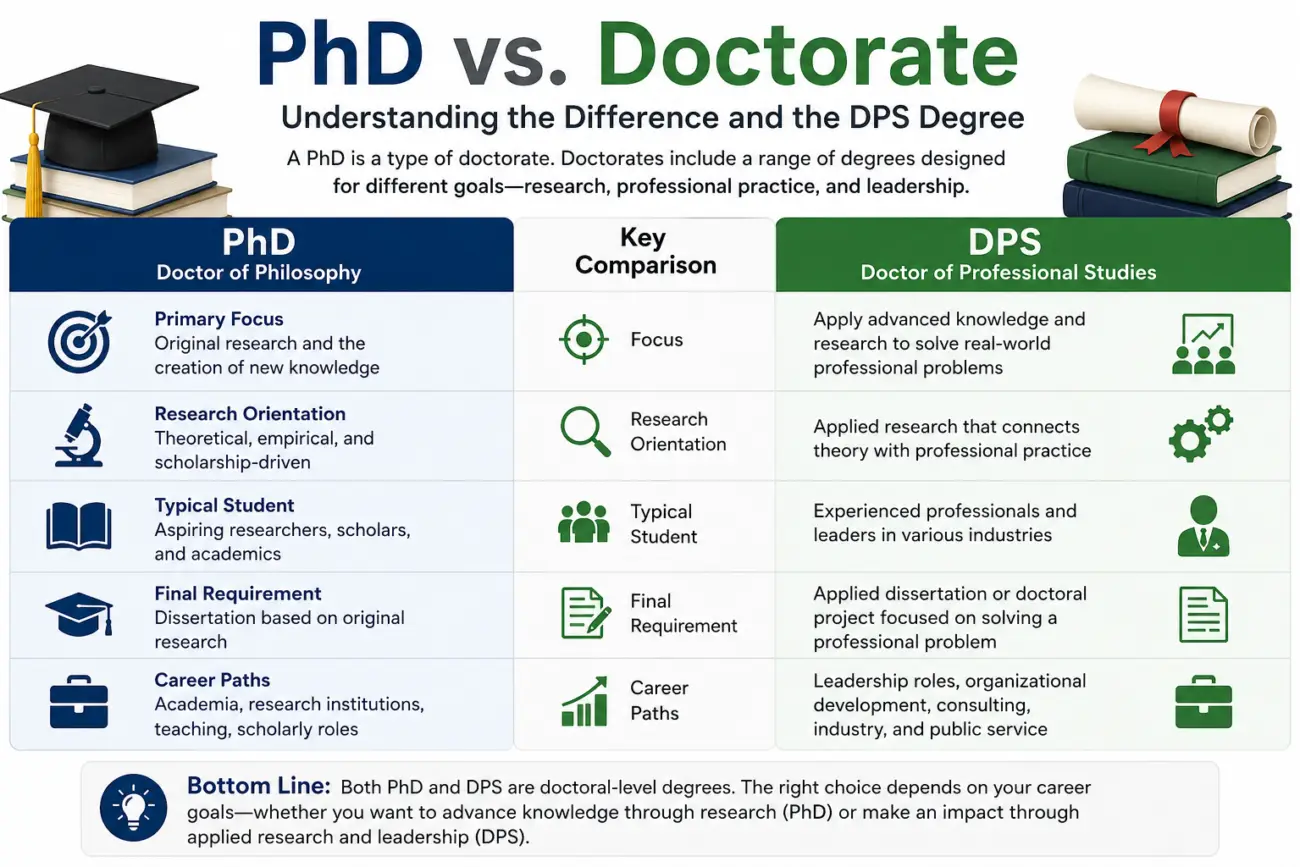
PhD vs. DPS at a Glance
| Comparison | PhD | DPS |
|---|---|---|
| Degree Level | Doctoral | Doctoral |
| Typical Focus | Original research and scholarship | Applied research and professional practice |
| Research Orientation | Often theoretical, empirical, or discipline-focused | Often practice-based and problem-focused |
| Typical Candidate | Aspiring or established researcher, scholar, or specialist | Often an experienced professional or leader |
| Primary Objective | Contribute new scholarly knowledge | Apply rigorous research to professional challenges |
| Career Orientation | Academia, research, specialist roles, industry | Professional leadership, organizational impact, consulting, industry |
| Final Requirement | Often a dissertation | May involve a dissertation, doctoral project, or another substantial applied research requirement, depending on the institution |
These distinctions are general rather than universal. Always review the curriculum and graduation requirements of the specific program you are considering.
What Does a DPS Student Study?
DPS curricula vary, but programs often combine advanced research capabilities with professional leadership and applied problem-solving.
Areas of study may include:
Applied Research
Students learn how to formulate research questions, select appropriate methods, gather evidence, analyze findings, and apply conclusions to professional contexts.
Leadership
Leadership coursework may examine organizational behavior, communication, decision-making, change management, team performance, and strategic leadership.
Strategy
Students may explore how organizations make complex decisions, respond to disruption, develop competitive approaches, and turn evidence into action.
Ethics
Advanced professionals frequently face decisions involving multiple stakeholders and competing priorities. Doctoral study may therefore include ethical frameworks, responsible leadership, governance, and professional accountability.
Evidence-Based Decision-Making
DPS students may learn to evaluate the quality of evidence rather than relying exclusively on assumptions, conventional practices, or personal experience.
The result is a doctoral experience designed to connect scholarly rigor with professional impact.
What Does a PhD Student Study?
PhD study varies significantly by discipline, but research training is usually central to the experience.
Students often develop advanced knowledge in:
Research Methodology
PhD candidates learn methods appropriate to their discipline, which can include qualitative, quantitative, experimental, computational, historical, or mixed-method approaches.
Specialized Subject Knowledge
Students typically focus on a narrow area within a broader academic discipline and develop expertise through extensive study of existing scholarship.
Scholarly Literature
Understanding what researchers already know is essential to identifying unanswered questions and opportunities for original contributions.
Data and Analysis
Depending on the field, students may collect and analyze numerical data, interviews, documents, observations, experiments, historical records, or other forms of evidence.
Original Research
A major objective of PhD education is developing the ability to independently investigate an important research question.
Dissertation Research
Many PhD programs culminate in a dissertation demonstrating the candidate’s ability to conduct substantial original research and communicate the findings according to scholarly standards.
Can Someone With a PhD Be Called a Doctor?
Yes. A person who has earned a PhD may use the title “Doctor.”
The title is based on having earned a doctoral-level academic qualification.
However, context matters.
In everyday conversation—particularly in healthcare—the word “doctor” is often understood to mean a physician. In universities and professional settings, the title may also refer to someone who has earned an academic or professional doctorate.
For that reason, professionals often clarify their credentials when there could be confusion.
PhD vs. DPS: Which Doctoral Degree Is Right for You?
Choosing between a PhD and a DPS should begin with your intended outcome rather than the prestige of the degree title.
Ask yourself what you want doctoral education to enable you to accomplish.
A PhD May Be a Better Fit If…
A PhD may align with your goals if you:
- Want to conduct extensive original research
- Are interested in an academic or research-intensive career
- Want to develop deep expertise within a specialized discipline
- Enjoy theory, research methodology, and scholarly investigation
- Want to contribute to an established body of academic knowledge
- Are considering university-level research or teaching
A DPS May Be a Better Fit If…
A DPS may align with your goals if you:
- Are an experienced professional
- Want doctoral research closely connected to professional practice
- Want to investigate real-world organizational or industry challenges
- Are interested in advanced leadership
- Want to strengthen evidence-based decision-making skills
- Want to apply research within your profession rather than pursue a primarily academic research career
Neither pathway is automatically better.
The right doctoral degree is the one whose curriculum, research model, faculty expertise, program requirements, and intended outcomes align most closely with what you want to accomplish.
Questions to Ask Before Choosing a Doctoral Program
Before enrolling in any doctoral program, investigate more than the degree abbreviation.
1. What Are Your Long-Term Career Goals?
Determine whether your goals involve academic research, university teaching, professional leadership, consulting, industry research, organizational transformation, or another specialized path.
2. What Kind of Research Do You Want to Conduct?
Consider whether you are more interested in investigating scholarly questions or applying research to problems arising from professional practice.
3. What Are the Program’s Research Requirements?
Look closely at whether the program requires a traditional dissertation, applied dissertation, doctoral project, portfolio, published research, or another culminating experience.
4. Who Is the Program Designed For?
Some doctoral programs are built primarily for researchers, while others target experienced working professionals. Admissions requirements and classroom experiences can reflect those differences.
5. Is the Institution Properly Recognized or Accredited?
Recognition and accreditation can affect how a credential is perceived and whether it satisfies professional, employment, licensing, or further-education requirements.
Requirements differ across countries and professions, so investigate the standards relevant to where you plan to use the degree.
6. Does the Format Fit Your Life?
Doctoral education is a major commitment. Consider scheduling, residency requirements, online or campus expectations, research demands, program length, and how the degree will fit alongside professional and personal responsibilities.
7. What Do Graduates Do With the Degree?
Program outcomes can provide useful context. Look beyond job titles and examine whether graduates are achieving outcomes similar to the ones you want.
PhD vs. Doctorate: The Bottom Line
The difference between a PhD and a doctorate becomes much easier to understand once you recognize that they are not competing academic levels.
A doctorate is the broader category. A PhD is one type of doctorate.
PhD programs typically emphasize original scholarly research and contributions to knowledge. Professional and applied doctoral programs can place greater emphasis on using rigorous research to address challenges within professional practice.
A Doctor of Professional Studies (DPS) is one example of a doctoral pathway that can connect research, leadership, evidence-based decision-making, and real-world professional problems.
When comparing a PhD vs. DPS—or any doctoral programs—the most important question isn’t simply which degree sounds more prestigious.
The better question is:
Which doctoral program best matches the research you want to conduct, the problems you want to solve, and the career you want to build?
The answer can help you choose a doctoral path based on purpose rather than title alone.
Frequently Asked Questions About PhDs and Doctorates
Is a PhD higher than a doctorate?
No. A PhD is itself a type of doctorate, so it is not inherently higher than the doctoral level. Different doctoral degrees can have different purposes, requirements, and professional applications.
Is every doctorate a PhD?
No. Every PhD is a doctorate, but not every doctorate is a PhD. Other doctoral degrees can include the EdD, DBA, PsyD, DrPH, DPS, and numerous discipline-specific credentials.
Is a DPS a doctoral degree?
Yes. DPS stands for Doctor of Professional Studies and is a doctoral-level qualification. Individual DPS programs can differ considerably in curriculum, research requirements, and professional focus.
What Is the Main Difference Between a PhD and a DPS?
A PhD generally emphasizes original scholarly research and contributions to academic knowledge. A DPS typically emphasizes advanced research connected to professional practice and real-world problems.
Is a DPS Equivalent to a PhD?
A DPS and PhD can both be doctoral-level degrees, but they should not be treated as identical credentials. Their research orientation, curriculum, admission requirements, final projects, and intended professional outcomes may differ.
Can You Use the Title “Doctor” With a PhD?
Yes. Someone who has earned a PhD can appropriately use the academic title “Doctor.” Context is important because the term can also refer to physicians and holders of other doctoral qualifications.
Is a Professional Doctorate Worth It?
A professional doctorate can be worthwhile when its curriculum, cost, research requirements, institutional recognition, and career outcomes align with your professional objectives. The value depends on your goals and the specific program rather than the degree title alone.
Should I Choose a PhD or a Professional Doctorate?
Consider a PhD if your primary interests involve original scholarly research, academia, or research-intensive work. A professional doctorate may be more appropriate if you want to combine advanced research with leadership and practical problem-solving in your profession.
