
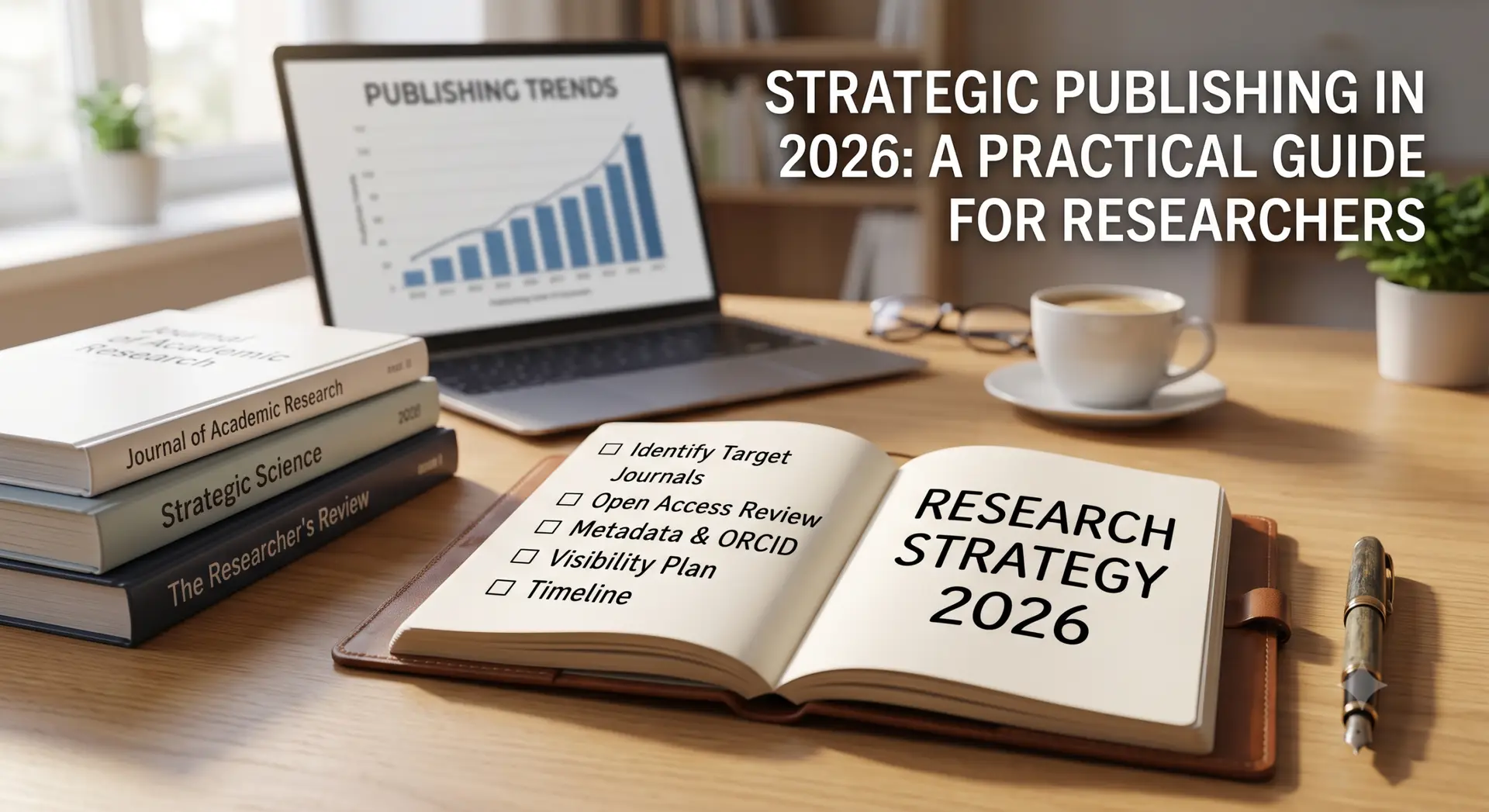
Most researchers do not need to publish more papers. They need to make better decisions about what to publish, where to publish it, and how each paper supports their larger goals.
Strategic publishing means treating every paper as an investment. Before spending months writing, ask one question:
What should this paper achieve?
It may help you establish expertise, reach a specific scientific community, support a funding proposal, influence agricultural practice, develop a collaboration, or complete a doctoral requirement. If you cannot define the intended result, you are not ready to choose a journal.
Start With the Destination

A common mistake is to complete a manuscript and only then search for a journal. This often produces a paper that is too broad for a specialist journal, too narrow for an interdisciplinary journal, or poorly aligned with the target audience.
Instead, decide three things before writing:
- Who must read the paper?
- What should they learn from it?
- What should happen after they read it?
For example, a study about nitrogen fertilizer and N₂O emissions can be positioned in several ways:
- For soil scientists, emphasize the mechanisms controlling emissions.
- For agronomists, emphasize fertilizer efficiency and crop yield.
- For climate researchers, emphasize mitigation potential.
- For policymakers, emphasize practical recommendations and national relevance.
The same dataset can support different stories, but one paper should have one central story. Trying to satisfy every audience usually creates an unfocused manuscript.
Build One Strong Message

Before writing the introduction, complete this sentence:
This study shows that ________, which matters because ________.
If the sentence is unclear, the manuscript will probably be unclear.
Your paper does not need to solve an entire global problem. It needs to make one defensible contribution. That contribution could be:
- new evidence;
- a better method;
- a useful dataset;
- a comparison that has not been conducted before;
- a result that challenges an assumption;
- a practical recommendation supported by data.
Remove analyses that do not support the central message. More tables, variables, and models do not automatically make a paper stronger. They can hide the result readers actually need.
Choose the Journal With a Simple Three-Level Strategy
Do not create a list of 20 journals. Select three:
Journal A: Ambitious but realistic
Choose a respected journal that regularly publishes work similar in quality, subject, and scale to your study. It should be competitive, but the paper must genuinely fit its audience.
Journal B: Best practical fit
This is often the most important choice. The journal should publish closely related research, reach the correct readers, and have requirements your study can satisfy.
Journal C: Reliable alternative
Choose a credible journal with a strong scope match and a reasonable publication process. It should not be a random destination selected after several rejections.
Evaluate the three journals using five questions:
- Has the journal published similar studies during the past two years?
- Will its regular readers care about your main result?
- Can you satisfy its methodological, data, and reporting requirements?
- Are its fees and publication conditions acceptable?
- Is its editorial and peer-review process transparent?
If the answer to the first two questions is no, do not submit, regardless of the journal’s reputation.
Write for the First Decision
Your first objective is not immediate acceptance. It is to pass the editor’s initial assessment.
Editors generally need to understand four things quickly:
- What problem does the paper address?
- What is new?
- Why does it matter to this journal’s readers?
- Is the evidence sufficiently rigorous?
Make these answers visible in the title, abstract, final paragraph of the introduction, and cover letter.
A useful abstract follows a simple order:
- The unresolved problem
- The objective
- The essential method
- The main quantitative result
- The practical meaning of the result
Do not fill the abstract with background information. Readers need the result.
Similarly, the cover letter should not repeat the abstract. It should explain why the paper belongs in that specific journal.
Stop Writing for Reviewers Alone
A technically correct paper can still be difficult to read. In 2026, researchers compete for attention as much as they compete for publication.
Help readers understand the paper quickly:
- Use one idea per paragraph.
- Give figures a clear purpose.
- Put the most important result first.
- Report effect sizes and uncertainty, not only statistical significance.
- Remove repeated explanations.
- Define abbreviations only when they are necessary.
- Connect each discussion paragraph to a specific result.
Every table and figure should answer a question. If you cannot explain what decision a figure supports, revise or remove it.
Use AI as an Assistant, Not as Evidence
AI can save time when improving structure, checking clarity, generating alternative titles, or identifying confusing sentences. It cannot take responsibility for your science.
A safe workflow is:
- Write the scientific argument yourself.
- Use AI to identify unclear or repetitive sections.
- Review every proposed change.
- Verify every factual statement and reference.
- Disclose AI use when required by the journal.
Never trust an AI-generated citation without opening and reading the original source. Never upload confidential manuscripts, unpublished data, personal information, or peer-review material without appropriate authorization.
The human authors remain responsible for every sentence, analysis, citation, and conclusion.
Prepare for Publication Before Submission
A paper is easier to publish when the project is organized from the beginning.
Before submitting, prepare:
- a clean dataset with understandable variable names;
- the final analysis code;
- a short explanation of how the data were processed;
- a record of software and package versions;
- clear author contributions;
- funding and conflict-of-interest statements;
- a realistic data-availability statement;
- a record of any AI tools used.
This is not administrative decoration. It protects you when reviewers question an analysis, when co-authors disagree about contributions, or when you need to reproduce a result several months later.
Turn the Strategy Into a Decision
Before submitting, pause and review the complete publication plan:
- Is the paper built around one defensible contribution?
- Is the intended audience clearly defined?
- Does the selected journal regularly publish comparable research?
- Can an editor understand the value of the paper from the title and abstract?
- Are the data, code, figures, author contributions, and required statements ready?
If any answer is unclear, delay submission and correct the weakness. A premature submission rarely saves time. It usually leads to editorial rejection, unnecessary revisions, or another complete submission process.
Publish With Purpose
Strategic publishing is not about producing the largest possible number of papers or targeting prestigious journals without considering fit. It is about ensuring that every manuscript has a clear purpose, a defined audience, a strong scientific message, and a realistic publication route.
The most useful question remains the first one:
What should this paper achieve?
When that answer is clear, decisions about the message, journal, structure, evidence, and communication become much easier. That is the difference between simply publishing a paper and publishing strategically.
